
18 Jul 2025
Why MAGA is now the biggest threat to ASEAN “centrality” and sovereignty
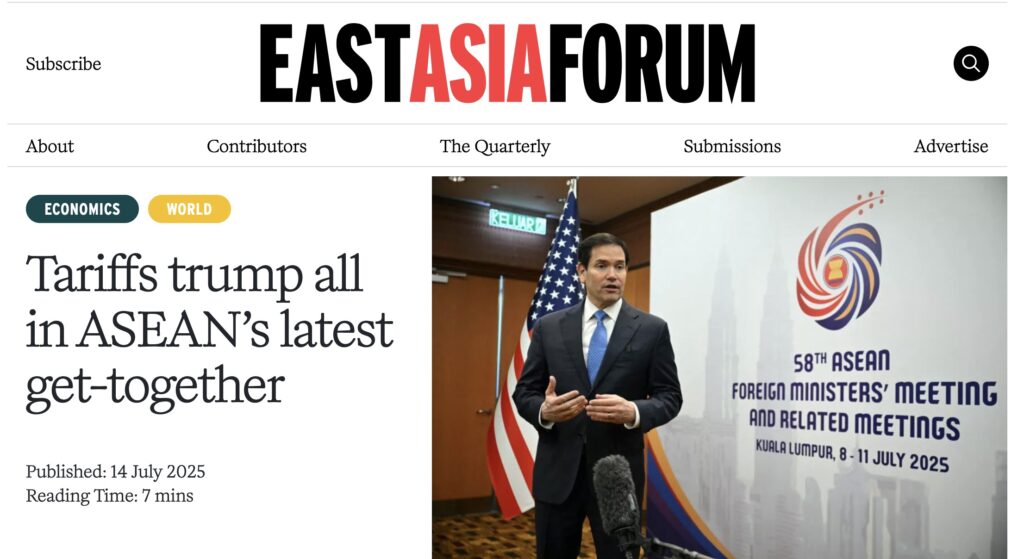
Bangkok – On 16 July, I attended an informal yet highly informative briefing by Mr. Bolbongse Vangphaen, Director-General of the Department of ASEAN Affairs, Ministry of Foreign Affairs, on the outcomes of the 58th ASEAN Foreign Ministers’ and Related Meetings, held from 8-11 July 2025 in Kuala Lumpur.
Organised by the MFA’s well-oiled Communications department, the briefing was intended to provide context and a big-picture summary of the outcomes. DG Bolbongse highlighted many of the positive takeaways, including the growing inter-regional connectivity, the free trade agreement with China, the interactions with the numerous dialogue partners, the efforts to enhance people-to-people cultural ties.


In the Q&A, not surprisingly, the unilateral imposition of U.S. tariffs dominated the discussion. I asked DG Bolbongse specifically how the ASEAN countries felt about both what is being done as well as the unprecedented way it is being done, via threats and intimidation, in violation of political and diplomatic norms and etiquette.
True to style, DG Bolbongse responded with extremely careful, diplomatically and politically correct language. In the meetings themselves, he said, the views were expressed in terms of commitments to principles, upholding multilateralism, the rules-based global trading system and international law. At the same time, individual countries have their unique interests in terms of trade and investment which determine how they deal with each scenario. Those interests also have to be respected.


What follows below is entirely my analytical takeaway from the briefing.
In the world of diplomacy, there is always a big difference between what is said in public, discussed privately and actually done.
A critical part of the Trump II administration’s Make America Great Again policy, the tariffs are a clear attempt to divide and rule the world to serve U.S. geopolitical and geoeconomic interests. Depending on their level of exposure to the U.S. market, ASEAN countries are being forced to break ranks and negotiate separate deals to safeguard the interests of their exporters.
That may or may not Make America Great Again but will certainly impact ASEAN. Given the diversity of the ASEAN economies, it is clearly a case of each country for itself.
The geoeconomic clash has been complicated by geopolitical factors, namely the Big-Power crossfires, which also involve the U.S. one way or another.
These include the Russia-Ukraine war in the European theatre, the Israel-Palestine war in the Middle East and the China-Taiwan tensions in the Asia-Pacific. On each of these, too, sharp policy differences exist between the U.S. and the ASEAN countries, both individually and collectively.
Although ASEAN countries have no direct or indirect involvement, the unstable operating environment complicates ASEAN attempts to deal with their own internal issues, such as the Myanmar situation, the recent Thai-Cambodian border issues and the China-Philippines maritime border in the South China Sea. In addition, countries such as Thailand are having to deal with domestic political controversies.
This combined set of global, regional and domestic conflicts risks destabilising the ASEAN by delaying the integration process, decision-making and implementation of the lofty goals under the new Vision 2045 roadmap approved at the ASEAN summit in May 2025.

In the midst of these swirling storms, the primary achievement of the Malaysian hosts was to prevent the Foreign Ministers and related meetings from erupting into slanging matches. DG Bolbongse complimented the Malaysians for ensuring an amicable, constructive atmosphere for discussion of all the other doing-business items on the agendas.
That may have papered over the cracks, but solved nothing. The conflicts will continue to rage. In terms of priority and intensity, however, MAGA is clearly the biggest and most immediate threat, as countries are forced into negotiating deadlines. The live-and-let-die policy also heightens the risk of ripple-effect consequences, especially if anti-Americanism breaks out.
I asked DG Bolbongse if the same threats and intimidation approach could be applied in other fora such as the U.N. if ASEAN countries cast votes on agenda items that contravene U.S. interests.
He said the ASEAN countries were well aware of that likelihood but that each situation would have to be dealt with it on its own merits. “We just have to remain steadfast in our principles and try to strengthen our capacity to deal with such changes in these policies by major powers. I don’t think any country is immune from it, including Thailand. So we just have to deal with it as best as we can based on collaboration with like-minded countries, by upholding all the various principles relating to violations of international law.”
The core takeaway is that the United States no longer abides by the “rules-based order” it helped set up.
The MAGA agenda has no qualms about weaponising both economic and foreign policies. As each country then has to decide how deeply it wishes to bow before the U.S., national sovereignty is as good as dead. So, too, is the cornerstone of ASEAN foreign policy, its “centrality”.
In 2027, ASEAN will be marking the 60th anniversary of its founding. Under normal circumstances, such anniversaries would have been cause for celebrations. The way things are going, however, there may not be much to celebrate.
As an economic sector highly vulnerable to “external shocks”, the Travel & Tourism industry in Thailand and across ASEAN will have to factor the high-risk scenario into all forward-planning strategies and be wary of exuberant “positive thinking.” The road ahead is very rocky indeed.