
10 Apr 2026
Prepare for post-war “consequences,” eminent Thai political scientist warns Thai travel industry
Bangkok – One of Thailand’s distinguished political scientists has warned the Thai Travel & Tourism industry to prepare for the “consequences” that will follow even after the Middle East conflict ends, including the “psychological” safety factors. The clear warning by Professor Emeritus Dr. Surachart Bamrungsuk, Faculty of Political Science at Chulalongkorn university, in a 27 March 2026 speech to the Association of Thai Travel Agents, has set the stage for a broader consideration of ALL the consequences that will hit long after the guns fall silent.
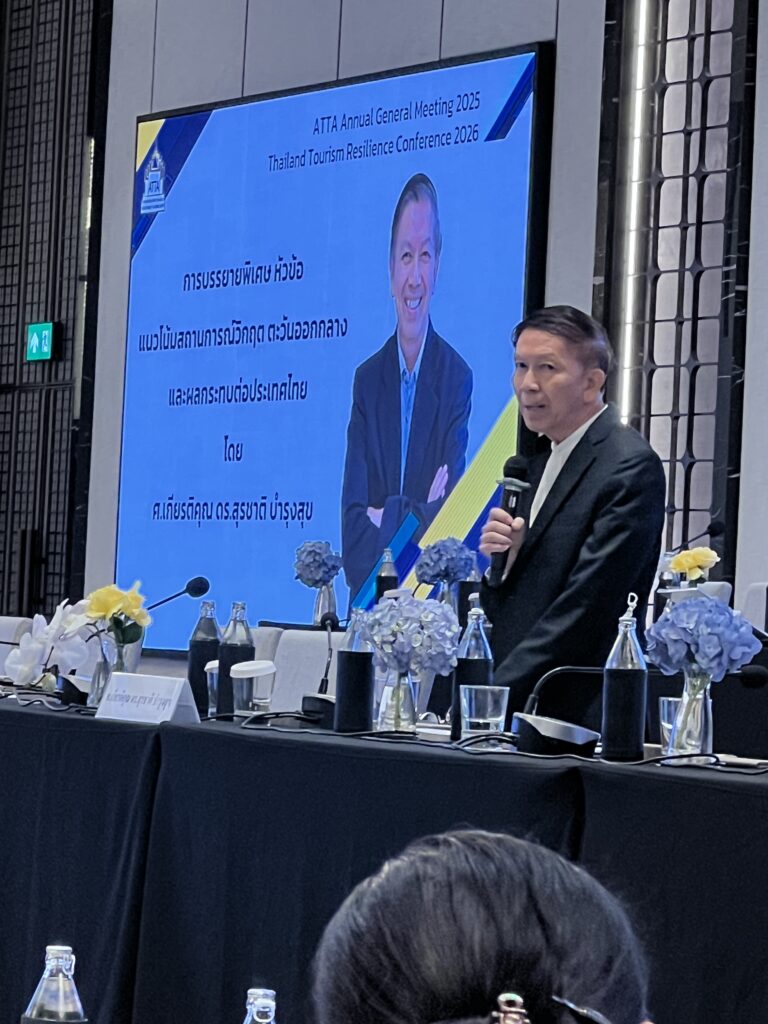
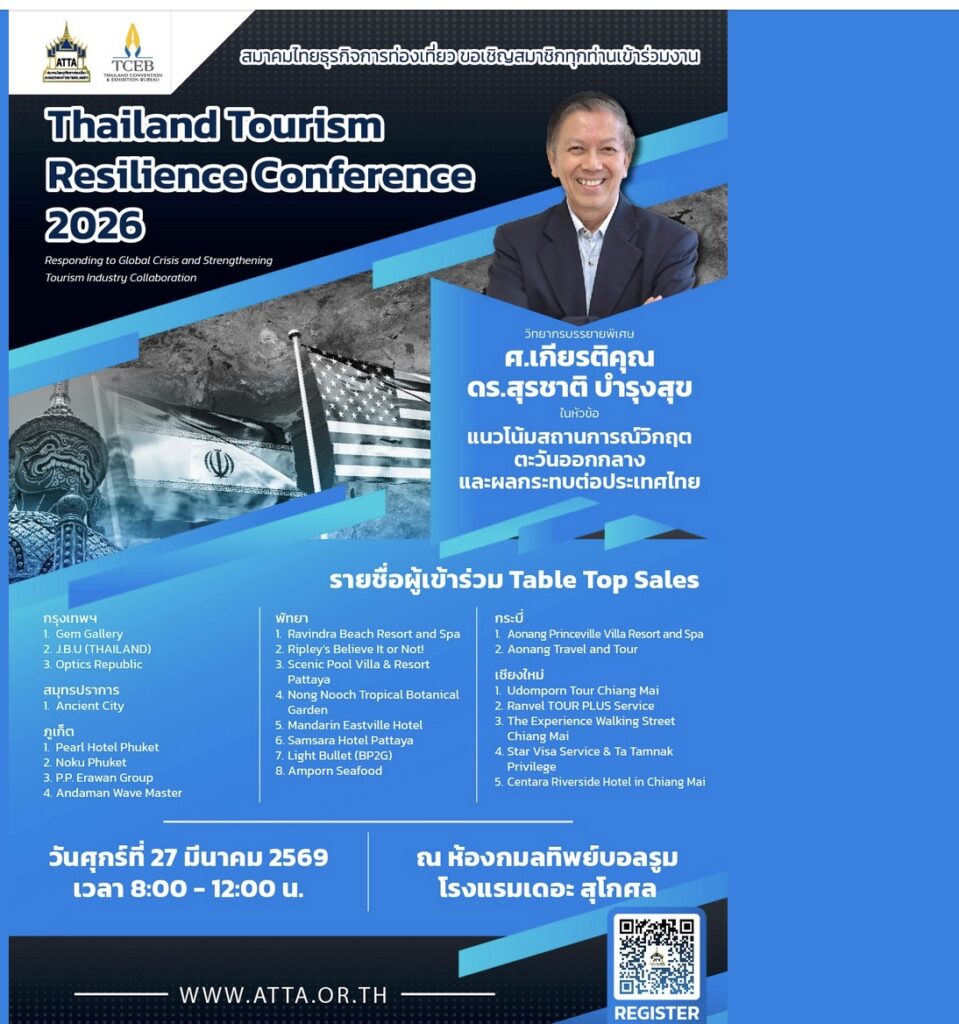
This was the first time this year that a Thai travel industry association had invited a political scientist to discuss what has become the most dominant topic on the Travel & Tourism agenda; the impact of geopolitics. Dr Surachat provided a comprehensive wrapup of the prevailing trends, timeframe, and impacts. Here is his exact warning on the future consequences:
“There’s one thing I’d like to emphasise. Just because a war ends doesn’t mean its consequences are over. Those of us who have been trained in warfare are taught that the consequences of war never truly end. This means that certain aftermath, such as energy prices, may not stabilise immediately. Regarding travel today, psychologically, what do tourists fear?
1. Tourists fear being stranded and unable to return home.
2. They fear not knowing what might happen after they’ve travelled.
3. As I mentioned earlier, tourism hubs sell security. Today, countries in the Gulf, especially Dubai, aren’t necessarily safe. So who would want to travel?
While people might want to travel, the hidden impact of these risks is still affecting their wallets – money drained from energy prices, the cost of living, food prices. In Europe, it’s a different story altogether, with apartment rentals being a major factor.
Faced with this, it leads to the possibility of a tourism crisis. I apologise for using that term, but I want to convey this message to you all. I usually focus on war-related issues, but I see the impact. If it reaches a critical point, I’d like to ask the association president and all of you on the committee to help each other. However, from another perspective, we need to find ways to communicate this to the government. Because tourism is one of the major engines of the Thai economy, it’s impossible for the Thai government to ignore it. However, if that’s the case, we need to find a way to involve the government sector in understanding the situation and problems of the impending tourism crisis.”
The above is a translation of his comments in Thai, which I am reproducing verbatim:
แต่อันนึงที่ขออนุญาตพูดอันนี้ต้องฝากนะครับ เวลาสงครามสงบไม่ได้บอกว่าผลสืบเนื่องจากสงครามจบนะครับ พวกผมที่ได้รับอบรมเรียนวิชาสงครามจะถูกสอนอย่างนึงคือ ผลสืบเนื่องจากสงครามไม่เคยจบ ณ วันที่สงครามจบ แปลว่าผลที่ตามมาบางอย่าง เช่น ราคาพลังงานอาจจะไม่นิ่งทันที การเดินทางของคนวันนี้ ถ้าเราบอกง่ายๆในเชิงจิตวิทยา นักท่องเที่ยวกลัวอะไร
1. นักท่องเที่ยวกลัวว่าเดินทางไปแล้วกลับบ้านไม่ได้เพราะไปตกค้าง
2. เดินทางไปแล้วไม่รู้จะเกิดอะไรขึ้น
3. กรณีของ Hub อย่างที่ผมเปิดประเด็นว่า เค้าขายความปลอดภัย วันนี้ประเทศในอ่าวโดยอย่างยิ่งในกรณีดูไบก็ไม่ได้มีความปลอดภัย
แล้วใครจะอยากเที่ยว ในขณะเดียวกันคนก็อาจจะอยากเที่ยว แต่พอมือตบที่กระเป๋า เป็นวิธีมองไม่เห็นที่มาจากตรงข้ามก็นำเงินออกไปอีก นำเงินจากราคาพลังงาน ล้วงเงินจากค่าครองชีพ ราคาอาหาร ถ้าเป็นยุโรปถูกล้วงใหญ่อีกเรื่องนึง คือค่าอาพาร์ทเม้นท์ พอเจอโจทย์อย่างนี้ มันก็ตอบได้ว่าโอกาสที่จะเห็นวิกฤตการท่องเที่ยว ขออนุญาติใช้คำนี้นะครับ ที่พูดเพราะอยากสื่อกับพวกเราเนื่องจากผม จริงๆแล้วทำแต่เรื่องสงคราม แต่เห็นผลกระทบ แล้วถ้ามันถึงจุดวิกฤต ก็ขออนุญาตจากนายกสมาคม ฝากถึงพวกเราที่เป็นกรรมการคงต้องช่วยๆกัน แต่ในมุมนึงเนี่ยคงต้องหาทางสื่อสารกับภาครัฐ เพราะการท่องเที่ยวคือหนึ่งในหัวรถจักรใหญ่ของเศรษฐกิจไทย รัฐบาลไทยไม่เอาการท่องเที่ยวเป็นไปไม่ได้เลย แต่ว่าถ้าอย่างนี้ต้องหาทางชวนภาครัฐเข้ามารับรู้สถานการณ์และปัญหาของวิกฤติการท่องเที่ยวที่กำลังจะเกิด
After offering a broad brushstrokes analysis of developments as at the time of his speech, he noted there was no way of predicting what happens next nor the timeframe. Why?
“The biggest uncertainty is that we can’t predict Trump’s actions. Even someone who knows all about astrology wouldn’t know how to answer that. I think it’s beyond what academics can answer. Trump is, to put it mildly, an inconsistent person. Anyone who has seen Trump’s interviews regarding Iran will know he changes his mind frequently. His statements during the same period show quite contradictory positions from the US, making it unclear what the US leader is really thinking.”
On the other side, he also cited the importance of Iran’s demands for respect of its sovereignty, and its determination to ensure its own safety and security from external threats.
He noted that what made this conflict more serious than others is the economic impact of disruptions in oil and shipping due to the closure of the Straits of Hormuz. This, he noted, is what is directly hitting Thailand, both in terms of tourism and economic impact. He called it a “crisis within a crisis”.
“War is like an invisible hand reaching into our wallets and taking our money, taking it from us and our families. But what follows the economic crisis is, most notably, an energy crisis, a transportation crisis, a crisis of food prices, a crisis of commodity prices, and finally, a crisis of the cost of living. I think this is the biggest war of life. Because the cost of living is everyone’s life, the life of every family.
I can say that this May, the start of the school term will be brutal because parents will have to pay tuition fees, not to mention school fees, books, and school uniforms. Many parents are struggling today, waiting for a measure to split tuition fees in half. Luckily, my children are grown up now. We see the fluctuations in everything that affects us in this crisis. This means that eventually, people will start saving money. And when you start saving money, the question arises: will you travel? I believe there are still many of us, or the Thai middle class, who haven’t felt the impact much yet and want to travel. But the question is, how much longer can this situation last?”
He noted that Tourism to Thailand will also be affected as airlines raise fares and restructure routes. That, in turn, will have a knock-on economic effect.
The only bright spot he saw on the horizon was the possibility that the US President may calm down if he fears the prospects of losing the upcoming Congressional elections later this year.
Later, in response to a question, he pointed out that Thailand, too, is facing the consequences of its own conflict with neighbouring Cambodia and the closure of access to the Preah Vihear temple from the Thai side. He gave a detailed history of that, dating back to his own early days in academia, and then posed the question:
“When we prioritise war because of conflicts with our neighbours, what do we gain? On the day (the late) Prime Minister Chatichai (Choonhavan) attended a cabinet meeting in the Northeast, some MPs from the Northeast during his time proposed a request for him to talk to the Cambodian government to open access to Preah Vihear Temple because Thailand wanted to open it to tourism. Then we closed it off since the conflict started after 2008. Let me ask you, what did we gain? I don’t want to talk about losing territory because the arguments led to Cambodia taking it to the International Court of Justice. If we talk seriously today, there are implications of territorial loss because of Thailand’s demands that became the problem and had to go back to the International Court of Justice.
“Today, our brothers and sisters in the region must think about living together, not starving together. When will we think about starving together? Today we can see it. Why? Let’s ask hypothetically, how much has Thai society grown economically? And when did this prosperity we see begin? Think about it. I’ll answer: it started during the era of Prime Minister Prem Tinsulanonda. Why? Because the communist insurgency ended, around 1982 and 1983.”
He also cited the impact on Thailand of the other conflict raging in neighbouring Myanmar.
“When our brothers and sisters in Myanmar come to work in our country, we send them back home on Honda Wave motorcycles. This means that Thailand, geographically, is a different kind of hub, similar to how the Gulf countries are hubs that we see. If this is the case:
1. Reduce the war situation and end the conflict by bringing our Cambodian labourers back. Otherwise, we ourselves cannot move forward, right?
2. What do we gain from both our border and domestic markets today?”
My Key Takeaway
After covering the local, regional and global ramifications of geopolitical uncertainty and instability, Prof Dr Surachat’s reference to future “consequences” has given the Thai Travel & Tourism a heads-up to start preparing for the upcoming risks and threats which will go well beyond geopolitical and economic boundaries. Now that a clear warning has been sounded, the Thai tourism industry leadership can no longer sweep them under the carpet.
The entire talk can be watched here (in Thai) https://www.facebook.com/share/v/1JtsR2grcL/