
28 Apr 2026
As global military spending grows, Travel & Tourism faces a perilous future
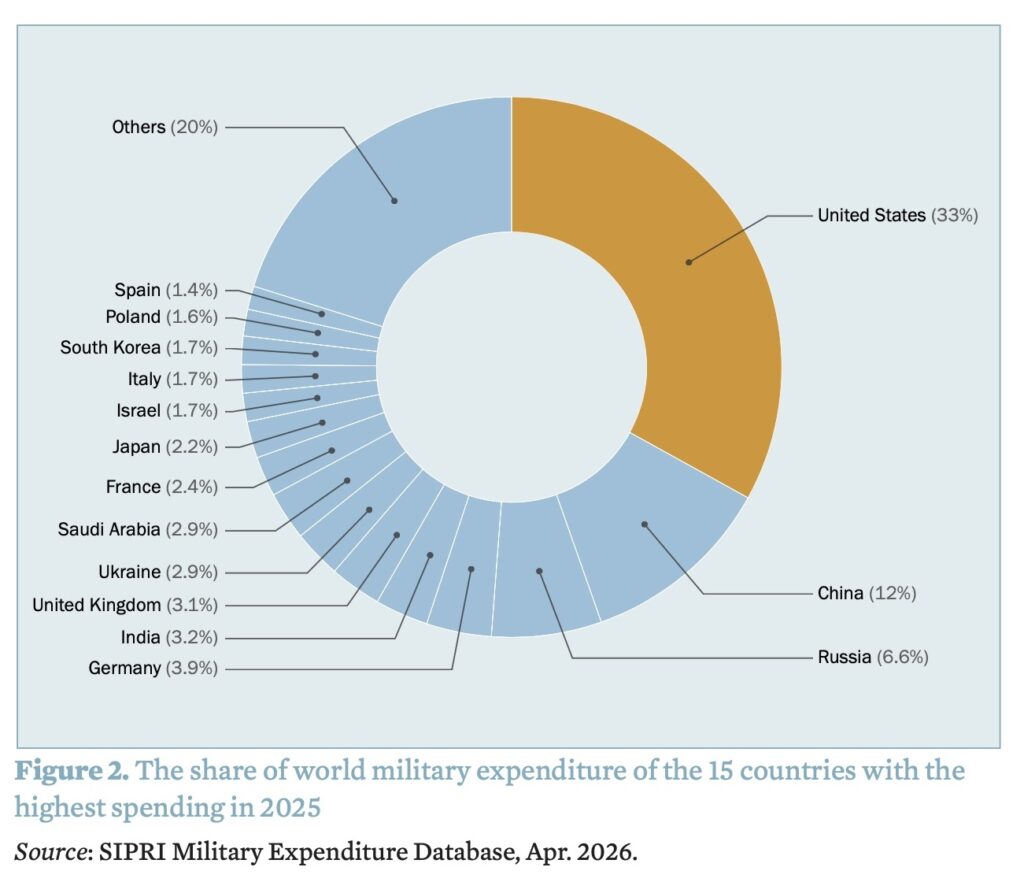
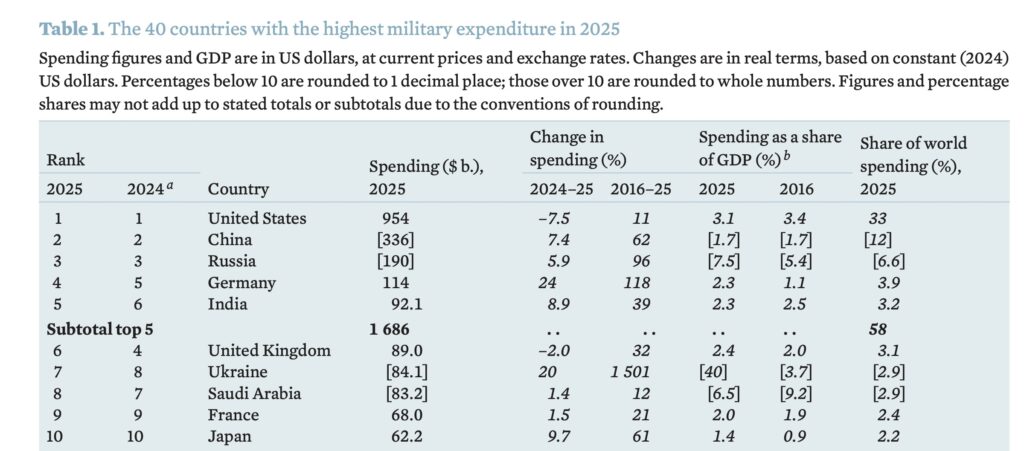
Barely has it recovered from the Covid-19 catastrophe, that Travel & Tourism again is in a slump. Millions of jobs are at risk. No such problems in the military sector, however. New data published on 26 April by the Stockholm International Peace Research Institute (SIPRI), showed that global military spending hit $2,887 billion in 2025, up 2.9% in real terms over 2024. The top three military spenders—the USA, China and Russia—spent a combined total of $1,480 billion, or 51% of the global total.
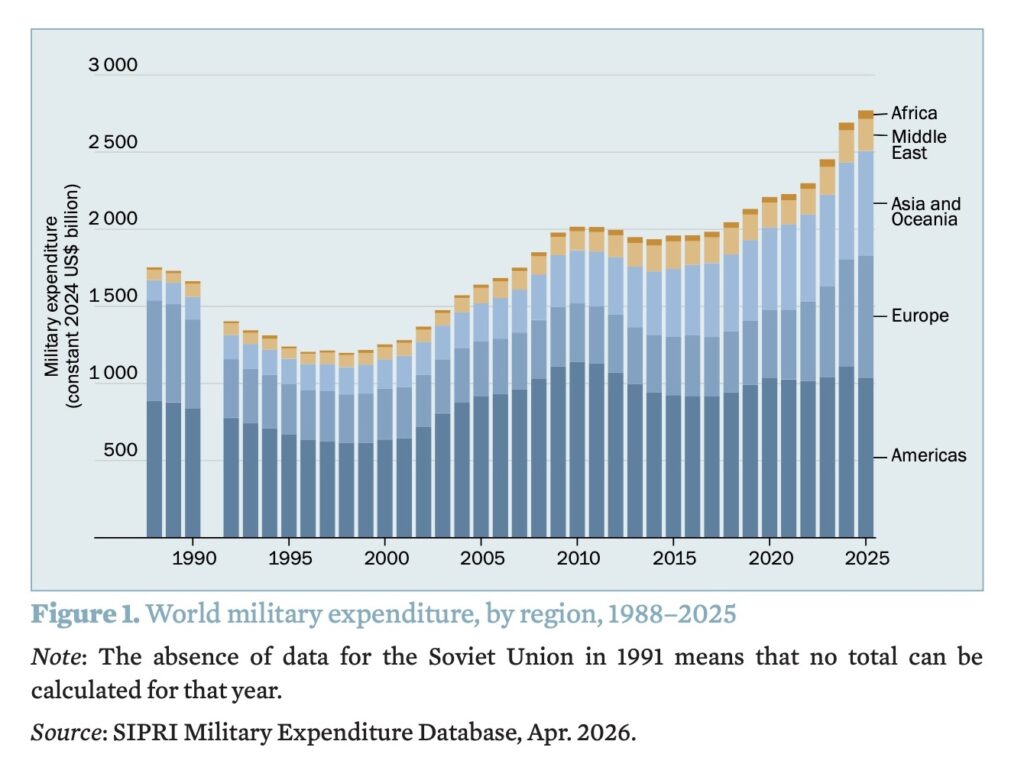
Growth prospects are good, too. Xiao Liang, Researcher with SIPRI’s Military Expenditure and Arms Production Programme is quoted in the press release as saying that higher military spending in 2025 was due to “another year of wars, uncertainty and geopolitical upheaval with large-scale armament drives.” He added, “Given the range of current crises, as well as many states’ long-term military spending targets, this growth will probably continue through 2026 and beyond.”
The Travel & Tourism industry, by contrast, is facing exactly the opposite prospects. Industry pundits, well-known for illusory “positive thinking,” believe that once the current conflicts in the Middle East are over, Travel & Tourism will bounceback big time, just as it does after every crisis. That projected bounceback, however, may be just as shortlived as the post-Covid “bounceback”. Peace and stability is not good for the bottom-lines of the merchants of death.
A close look at the obscene military expenditures for 2025 will send shockwaves through Travel & Tourism. Having analysed the SIPRI report carefully, here are a few takeaways designed to get the “industry of peace” to consider the deeper financial, geopolitical, economic and environmental implications of this sheer waste of precious funds. Here are just some to consider.
[] More conflicts and wars are a foregone conclusion. The arms bazaar needs wars and conflicts to boost business and deliver shareholder value. Each round of wars and conflicts lead to detailed analysis of the hardware performance, and more research to fix the weaknesses and upgrade the weapons systems. Those in turn have to be find buyers to recoup the investment. That means the cycle of violence will continue to turn for years ahead.
[] The United States’ military spend of US$954 billion comprised 3.1% of its GDP and 33% of the world total. This makes it a major contributor to economic growth and jobs. The same in other countries, such as Russia, China, India and Israel. Many other countries are jumping on the bandwagon for the same reason. What are the implications of that?
[] Multiple Travel & Tourism forums are now devoted to “sustainability”. But the UN itself admits that the UN Sustainable Development Goals are unattainable by the 2030 target date. One reason cited is that there is a shortage of money. That alone begs the question: Why is there a shortage of money for fighting poverty or safeguarding the environment but no shortage of money for wars and conflicts? Serious questions are arising about the need to rebalance this expenditure away from the military-industrial complex towards the UNSDGs. Last November, SIPRI issued another study on precisely this topic. What can the Travel & Tourism do to lend its voice to this movement?
[] There is little analysis about the direct environmental impact of the military-industrial complex and the critical minerals and precious metals which have to be mined, transported and assembled to manufacture all those fighter aircraft, naval ships, missiles, etc. How much damage do they cause and who pays both the price and the costs of that damage? That question, too, is getting increasing traction.
[] Arms deals are cloaked in secrecy and known to be rife with kickbacks and corruption. That adds many more layers of complexity into the system.
[] Higher military expenditures have a direct impact on national development. In country budgets, higher military expenditures, justified by the national defence authorities for national security reasons, divert funds from other productive uses such as education and health.
[] All wars worsen the situation on the ground and impact the most vulnerable. They leave behind thousands of bereaved families and handicapped individuals who need a lifetime of care. Calculating the human cost of these wars will significantly expand the indirect ripple-effect triggered by military expenditures.
[] Rampant use of military equipment, especially drones, is posing a direct threat to safety and security of the travelling public. In the Gulf countries, airports and hotels were hit by explosives-laden drones. This can now happen anywhere.
[] Wars and conflicts become excuses for politicians to rally public around nationalism, triggering xenophobia and jingoism, none of which are good for Travel & Tourism.
[] Military personnel and businesses are big spenders on private jets, travel and entertainment and MICE events. Reductions in those budgets will probably be of more concern to Travel & Tourism than any amount of human misery.
[] The SIPRI figures do not include the billions being spent on non-military safety and security equipment such as cameras, snooping devices, personal protective gear, access control and surveillance cameras (CCTV). Nor do they include sales to non-state actors. This means the actual figure is far higher.
Here are some specific stats and trends identified in the latest SIPRI report which should provide food for thought.
The United States
At $954 billion, military spending by the United States was 7.5% lower in 2025 than in 2024. The drop was primarily due to the fact that no new financial military assistance for Ukraine was approved during the year. This was in sharp contrast to the previous three years, when a total of $127 billion was approved.
However, the USA increased investments in both nuclear and conventional military capabilities to maintain dominance in the Western Hemisphere and deter China in the Indo-Pacific, which are key goals of the new National Security Strategy.
‘The decline in US military expenditure in 2025 is likely to be short-lived,’ said Nan Tian, Programme Director of the SIPRI Military Expenditure and Arms Production Programme. ‘Spending approved by the US Congress for 2026 has risen to over $1 trillion, a substantial increase from 2025, and could rise further to $1.5 trillion in 2027 if President Trump’s latest budget proposal is accepted.’
Europe
The main contributor to the global increase in military spending in 2025 was a 14% rise in Europe to $864 billion. Spending by Russia and Ukraine continued to grow in the fourth year of the war in Ukraine, while ongoing rearmament efforts by European NATO members led to the sharpest annual growth in spending in Central and Western Europe since the end of the cold war.
Russia’s military spending grew by 5.9% in 2025 to $190 billion, giving it a military burden of 7.5% of GDP. Ukraine, the seventh largest spender in 2025, increased its spending by 20% to $84.1 billion, or 40% of GDP.
‘In 2025 military expenditure as a share of government spending reached the highest level ever recorded in both Russia and Ukraine,’ said Lorenzo Scarazzato, Researcher with the SIPRI Military Expenditure and Arms Production Programme. ‘Their spending is likely to keep growing in 2026 if the war continues, with revenues from Russia’s oil sales increasing and a major European Union loan expected by Ukraine.’
The 29 European NATO members spent a combined total of $559 billion in 2025, and 22 of them had military spending of at least 2.0% of GDP, according to SIPRI’s methodology. Germany was the largest military spender in the group, with its expenditure growing by 24% year-on-year to $114 billion. Germany’s military burden exceeded the 2.0% threshold for the first time since 1990, reaching 2.3% of GDP in 2025. Military spending by Spain increased by 50% to $40.2 billion, also bringing its military burden above 2.0% of GDP for the first time since 1994.
‘In 2025 military spending by European NATO members rose faster than at any time since 1953, reflecting the ongoing pursuit of European self-reliance alongside increasing pressure from the United States to strengthen burden sharing within the alliance,’ said Jade Guiberteau Ricard, Researcher with the SIPRI Military Expenditure and Arms Production Programme. “As states strive to meet the new NATO spending targets agreed in 2025, there is a risk that the boundaries between military and other “defence- and security-related” expenditures become blurred, reducing transparency and further complicating the assessment of military capabilities.’
Spending in Middle East stable despite ongoing conflicts and regional rivalries
Middle East
Military expenditure in the Middle East reached an estimated $218 billion in 2025, just 0.1% higher than in 2024. Besides Israel, most of the other major spenders in the region for which data is available increased their spending.
The military expenditure of Israel decreased by 4.9% to $48.3 billion, reflecting a reduction in the intensity of the war in Gaza during 2025 after the ceasefire agreement with Hamas in January 2025. Nevertheless, Israel’s spending remained 97% higher than in 2022. Military spending by Türkiye grew by 7.2% in 2025 to $30.0 billion, partly driven by its ongoing military operations in Iraq, Somalia and Syria.
Spending by Iran declined for the second consecutive year, falling by 5.6% to $7.4 billion in 2025. The real-terms decrease was due to high annual inflation of 42%, and spending increased in nominal terms.
‘Despite the recent conflicts, Iran’s military spending decreased in real terms due to economic difficulties,’ said Zubaida Karim, Researcher with the SIPRI Military Expenditure and Arms Production Programme. ‘However, official figures almost certainly understate the true level of Iran’s spending—Iran also uses off-budget oil revenues to finance its military, including the production of missiles and drones.’
Asia and Oceania
Military expenditure in Asia and Oceania totalled $681 billion in 2025, 8.1% higher than in 2024—the largest annual rise since 2009. China, the world’s second largest military spender, increased its military spending by 7.4% to $336 billion. This was the 31st consecutive year-on-year increase as China continued it essible at www.sipri.org.
Note by SIPRI: All percentage changes are expressed in real terms (constant 2024 prices). Military expenditure refers to all government spending on current military forces and activities, including salaries and benefits, operational expenses, arms and equipment purchases, military construction, research and development, and central administration, command and support.