
24 Apr 2026
What Does Revisiting The UN Charter Have To Do With Travel & Tourism? Read This…
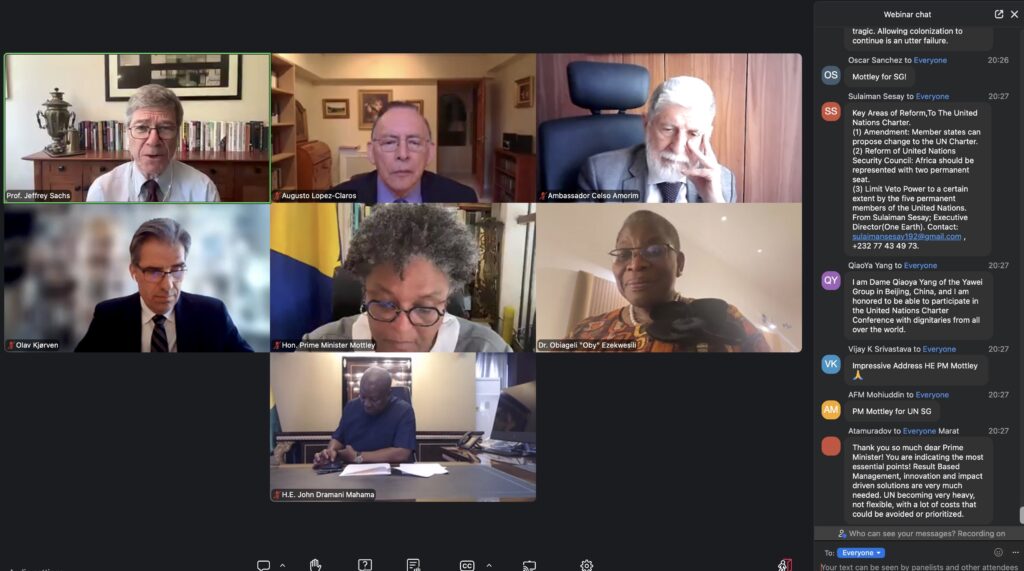
On 23 April, I attended a high-level webinar moderated by Prof. Jeffrey Sachs, President of the UN Sustainable Development Solutions Network (SDSN), on the topic “Revisiting the UN Charter in a Changing Global Order.” It was a pleasure to hear insightful and thought-provoking perspectives from Prof Sachs and his distinguished panelists:
(+) Mrs Mia Amor Mottley, Prime Minister, Barbados.
(+) Ambassador Celso Amorim, Chief Advisor to the President of Brazil for Foreign Policy
(+) Mr. Domingos Estevão Fernandes, Permanent Representative of Mozambique to the UN
(+) Dr. Obiageli Ezekwesili, Economic Policy Expert and Advocate, and Former Minister of Education and Minister of Solid Minerals for Nigeria
(+) Mr. Olav Kjorven, Senior Advisor, Article 109 Coalition
(+) Mr. Augusto Lopez-Claros, Executive Director and Chair, Global Governance Forum
What does reforming the UN Charter have to do with Travel & Tourism?
Very simple. The UN system is controlled by a quintet of countries who hold veto power over core decision-making. They decide whether to wage war or peace, based on their own interests, not the rest of the 193 UN members.
When wars and conflicts break out, with or without UN Security Council approval, the countries at the lowest rung of the economic ladder are the worst affected even though they have the least say.
Today, two UN Security Council members are themselves involved in direct hot wars hurting the rest of the world.
The developing countries, many of them dependent on Travel & Tourism as an economic lifeline, are demanding a change in this one-sided, highly unstable and decidedly undemocratic system.
That requires changing the UN Charter, in existence since the formation of the UN in 1945, and now clearly obsolete and irrelevant.
The legal and diplomatic hurdles facing that task was the core topic of discussion at the webinar.
This year, UN Secretary General Antonio Guterres is stepping down at the end of his term. Political wrangling is under way to appoint a a new Secretary-General. That alone will delay the process.
In the meanwhile, the chances of continued geopolitical uncertainty are very, very high.
That, in turn, heightens the risk and threats facing Travel & Tourism.
Which is why Travel & Tourism leaders, especially in the developing countries, need to see how they can support their respective governments in pushing for change.
There are many ways of doing that, but only if they first drop their “we-can-do-nothing-about-it” mindset.
Prof Sachs’ webinar was the last of a four-part series, Global Governance for Peace and the SDGs, examining critical issues shaping the future, including the geopolitics of war and peace, accelerating SDG implementation, the post-2030 agenda, and reform of the UN system.
Key takeaways included:
(+) Strengthening fair representation and power balance in the UN Security Council, especially for Africa and the Global South, can enhance the UN’s legitimacy and effectiveness.
(+) The UN Charter must be updated to better reflect today’s realities, including shifting demographics, climate challenges, and rapid technological change.
(+) Greater political cohesion, stronger long-term planning, and more robust, enforceable mechanisms are essential to making global governance more impactful.
(+) UN reform efforts must integrate regional cooperation to better reflect local realities.
(+) Building on past efforts, deeper and more innovative reforms can unlock meaningful transformation for multilateralism.
If any of our “visionary thought-leaders” in Travel & Tourism have comments on this topic, please post them below.